

Quartz flooring installation succeeds or fails on preparation. Most problems, such as peeling, bubbling, and uneven texture, trace back to choices made before the first coat goes down. The material is extremely durable, but only when the concrete is ground, tested, and primed correctly and the system is matched to how the space will be used.
This guide is for Maui homeowners, property managers, and business owners comparing flooring options. It covers what quartz flooring is, how professionals install it, and what it costs.
What Is Quartz Flooring?
Quartz flooring is a resin floor system made of colored quartz granules locked into layers of epoxy and sealed with a clear topcoat. The quartz adds texture, color, and hardness. The resin bonds everything to the concrete.
The term covers two different product types, so it helps to separate them:
- Quartz broadcast systems: Liquid epoxy is applied to concrete, then quartz aggregate is “broadcast” (scattered by hand) into the wet resin. This is the system Maui Epoxy Solutions installs for garages, commercial kitchens, lanais, and showrooms.
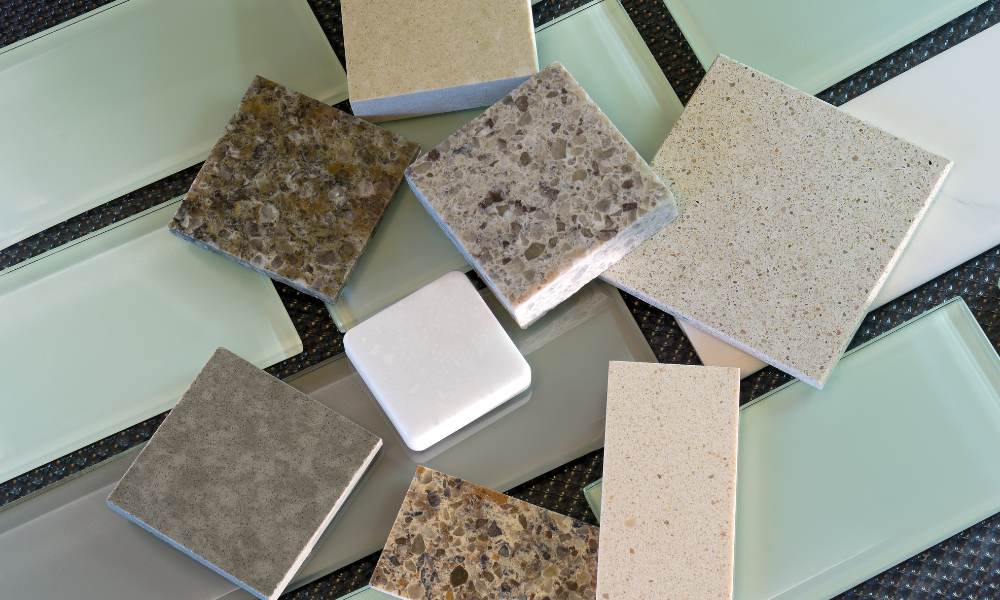
- Engineered quartz tiles and slabs: These are factory-made panels of about 90–94% crushed quartz bound with polymer resin. They are installed like stone tile.
Most of this guide focuses on broadcast systems, with a dedicated section on tiles and slabs. If you are unsure which you need, look at your subfloor first. Concrete slabs suit broadcast systems, while wood-framed floors usually call for tile.
Is Quartz Good for Flooring?
Yes. Quartz ranks 7 on the Mohs hardness scale, harder than steel tools and most household abrasives. That hardness makes quartz flooring one of the most wear-resistant decorative finishes for concrete.
What are the main benefits of quartz flooring?
- Slip resistance: The granules create a textured surface. Installers can make it grippier or smoother by adjusting aggregate size and topcoat thickness.
- Durability: A double-broadcast system is about 1/8 inch (125 mils) thick. That is roughly 30–40 times thicker than a standard roll-on epoxy coat.
- Chemical and stain resistance: Cured epoxy resists oils, cleaners, food acids, and most automotive fluids.
- Hygiene: The finished surface is non-porous and has no grout lines, which leaves bacteria fewer places to hide. This is why commercial kitchens and locker rooms specify it.
- Design range: Blended quartz colors range from neutral grays to custom mixes that match a brand or interior palette.
On Maui, slip resistance matters wherever floors get wet, including pool decks, outdoor showers, lanais, and restaurant prep areas. If your space sees water, ask your installer about texture levels before you choose colors.
How Is Quartz Flooring Installed? (Step-by-Step)
Professional quartz flooring installation follows a layered sequence. A typical residential garage or commercial room takes 2–4 days from prep to final coat.
- Inspect and test the concrete. Check for cracks, spalling, old coatings, and contamination. Measure moisture using ASTM F2170 (in-slab relative humidity) or ASTM F1869 (calcium chloride test). High moisture vapor emission is the most common cause of coating failure in Hawaii.
- Grind the surface. Diamond-grind the slab to a concrete surface profile (CSP) of 2–3, a texture standard set by the International Concrete Repair Institute (ICRI). Acid etching does not create a dependable profile.
- Repair cracks and joints. Fill cracks with epoxy or polyurea crack filler and grind it flush.
- Apply the primer. Roll a penetrating epoxy primer into the concrete. If moisture readings are high, apply a moisture-mitigating primer instead.
- Apply the body coat. Spread pigmented or clear epoxy with a notched squeegee and backroll it for even thickness.
- Broadcast the quartz. Scatter quartz granules into the wet epoxy “to refusal,” meaning until no wet resin shows through.
- Remove excess and repeat. After the coat cures, sweep or vacuum loose granules, lightly sand high spots, and repeat steps 5–6 for a double-broadcast system.
- Apply the grout coat. Squeegee a clear epoxy coat over the quartz to fill gaps and lock in the aggregate.
- Seal with a topcoat. Finish with a UV-stable polyaspartic or aliphatic polyurethane topcoat. This layer controls gloss, texture, and sunlight resistance.
Standard epoxy yellows (ambers) in direct sun. Any quartz floor on an open lanai or near large windows needs a UV-stable topcoat to keep its color. Request a written spec sheet from your installer that names the primer, body coat, and topcoat products.
What Subfloor Preparation Does Quartz Flooring Need?
Quartz flooring needs a clean, sound, dry, and profiled substrate. Preparation accounts for about half of the labor on most projects.
How do you prepare concrete for quartz flooring?
Preparation starts with removing anything that blocks adhesion, including paint, sealers, curing compounds, and oil stains. The slab is then ground to CSP 2–3 and vacuumed with a HEPA dust collector.
New concrete needs time to cure first. The common benchmark is 28 days, but moisture testing is the real deciding factor because Maui’s humidity slows drying.
Does quartz need plywood under it?
This depends on the product:
- Broadcast systems: These go directly on concrete, with no plywood involved.
- Quartz tiles over wood framing: Do not set tile directly on plywood. Install cement backer board or an uncoupling membrane (such as Schluter DITRA) over a stiff plywood subfloor. Wood flexes and moves with humidity, and that movement cracks tile and grout.
- Stiffness requirements: The Tile Council of North America (TCNA) calls for floor deflection of L/360 for ceramic tile and L/720 for natural and engineered stone.
Before you buy materials, confirm your joist spacing and subfloor thickness meet the stone deflection standard.
Quartz Tiles vs. Quartz Slabs: Which Should You Choose?
Quartz tiles are the practical choice for most floors. Slabs are heavy, expensive, and better suited to countertops.
|
Feature |
Quartz Tiles |
Quartz Slabs |
Quartz Broadcast System |
|
Format |
12″–48″ units |
Large sheets (~55″ x 120″) |
Poured, continuous |
|
Weight |
Moderate |
~13–20 lbs per sq ft |
Lightweight |
|
Seams |
Grout lines |
Few, visible seams |
None |
|
Best for |
Interiors, bathrooms |
Feature areas |
Garages, commercial, lanais |
|
DIY-friendly |
Moderately |
No |
No |
How do you install quartz tiles?
- Prepare the subfloor. Confirm it is flat, stiff, and clean.
- Dry-lay the layout. Plan cuts so you avoid thin slivers at walls.
- Spread thin-set mortar. Use a notched trowel sized for the tile.
- Back-butter large tiles. Coat the tile back for full coverage.
- Set and level. Press the tiles in and use spacers and a leveling system.
- Cut with a wet saw. Use a continuous-rim diamond blade to prevent chipping.
- Grout after 24–48 hours. Remove spacers, grout the joints, and wipe off the haze.
Can you put a quartz slab on a floor?
Yes, but it takes structural review and professional handling. Slabs need a reinforced subfloor, heavy-duty stone adhesive, and precise seam alignment.
Engineered quartz slabs and tiles are also rated mainly for indoor use. Most manufacturers warn that UV exposure can cause fading. For any outdoor surface on Maui, a resin broadcast system is the stronger option.
What Is the Best Adhesive for Quartz Tiles?
The best adhesive for quartz tiles is a polymer-modified thin-set mortar that meets ANSI A118.15 (improved modified mortar). Engineered quartz is dense and absorbs almost no water, so standard unmodified mortar bonds poorly.
Look for these features:
- Polymer-modified formula: Improves grip and flexibility on dense surfaces.
- Large-and-heavy-tile (LHT) rating: Required for tiles over 15 inches on any side.
- Non-sag properties: Keeps heavy tiles from slumping during setting.
- White mortar for light tiles: Prevents gray shadowing through pale quartz.
Products such as MAPEI Ultraflex LFT and Custom Building Products MegaLite fit these requirements. Check the quartz manufacturer’s installation guide, because using an unapproved mortar can void the warranty.
How Long Does Quartz Flooring Take to Cure?
Quartz flooring takes 5–7 days to cure fully, depending on the resin system and temperature. Each traffic level has its own wait time:
- Light foot traffic: 12–24 hours after the topcoat
- Furniture and normal use: 48–72 hours
- Vehicles and heavy equipment: 5–7 days
- Full chemical resistance: 7 days
Polyaspartic topcoats cure faster than traditional epoxy, often allowing foot traffic within a few hours. Heat and humidity affect cure speed. Maui’s warm temperatures speed curing, while high humidity can cause blushing (a cloudy surface film) if conditions are not controlled.
Ask your installer for a written return-to-service schedule so you can plan move-in dates or business closures.
How Much Does Quartz Flooring Installation Cost?
Quartz flooring installation typically costs 6–14 per square foot on the U.S. mainland. Maui projects often run higher because materials are shipped to the island.
What affects the price of quartz flooring?
- Concrete condition: Removing old coatings or repairing heavy damage adds labor.
- Moisture mitigation: Damp slabs need specialty primers.
- System thickness: Double-broadcast costs more than single-broadcast.
- Topcoat choice: UV-stable polyaspartic costs more than epoxy but outlasts it outdoors.
- Project size: Larger areas lower the per-square-foot price.
- Access and logistics: Upcountry, Hana, or multi-level sites can add travel and setup time.
A properly installed quartz system lasts 15–20+ years with basic upkeep. Cheaper coatings often need recoating within 3–5 years. To compare quotes fairly, request an itemized estimate that lists prep method, mil thickness, and product names.
How Do You Maintain Quartz Flooring?
Quartz flooring needs little maintenance. Regular sweeping and pH-neutral cleaning keep it looking new for years.
- Sweep or dust-mop daily in high-traffic areas. Sand acts like sandpaper on the topcoat, so this matters most near beaches.
- Mop weekly with a pH-neutral cleaner diluted in warm water.
- Avoid harsh chemicals such as bleach, vinegar, and citrus cleaners, which dull the topcoat over time.
- Use an auto-scrubber with soft pads in commercial spaces.
- Rinse salt residue from lanais and pool decks so it does not build up.
- Recoat the topcoat every 5–10 years in heavy-traffic or outdoor areas.
Place walk-off mats at entryways. They catch grit before it reaches the floor.
Why Choose Professional Quartz Flooring Installation on Maui?
Professional installation protects your investment. Quartz systems involve timed chemical reactions, precise thickness control, and moisture testing that most DIY projects skip.
Maui adds its own challenges. Coastal humidity, salt air, volcanic soil moisture, and strong UV exposure all affect how coatings bond and age. Maui Epoxy Solutions installs quartz flooring across the island, including in Kihei, Wailea, Wailuku, Kula, Makawao, and Pukalani. Our crew selects primers and topcoats based on Hawaii’s conditions, not mainland defaults.
We install quartz flooring for:
- Residential garages, lanais, and pool decks
- Commercial kitchens and restaurants
- Retail showrooms and offices
- Locker rooms, showers, and wet areas
- Warehouses and light industrial facilities
Every project starts with a site visit, moisture testing, and a written scope that names the products and process.
Get Your Quartz Flooring Quote
Your floor’s performance depends on what happens before installation day. Request a free quote from Maui Epoxy Solutions or call (808) 666-1278 to schedule an on-site assessment. You can also explore our quartz flooring systems to compare finishes and colors.
Frequently Asked Questions About Quartz Flooring Installation
How long does quartz flooring installation take?
Most quartz flooring installations take 2–4 days, plus 5–7 days for full cure. Large commercial spaces or slabs with moisture problems can take longer.
Is quartz flooring slippery when wet?
No. The quartz granules create natural texture. Installers can add fine aggregate to the topcoat for extra grip on pool decks, showers, and commercial kitchens.
Can quartz flooring be installed outdoors in Hawaii?
Yes, if the system uses a UV-stable topcoat such as polyaspartic or aliphatic polyurethane. Standard epoxy yellows in direct sunlight.
Can you install quartz flooring over existing tile?
Sometimes. The tile must be firmly bonded, ground to profile, and free of cracks. In most cases, removing the tile gives a more dependable bond to bare concrete.
What is the difference between quartz flooring and epoxy flake flooring?
Quartz flooring uses fully broadcast quartz granules for a harder, more textured, and more slip-resistant surface. Flake flooring uses vinyl chips that are more decorative and cost less, but resist abrasion less well.
How long does quartz flooring last?
A professionally installed quartz flooring system lasts 15–20 years or more. Recoating the topcoat every 5–10 years extends its life further.
Can I install quartz flooring myself?
DIY quartz tile installation is possible with tile experience. Resin broadcast systems require diamond grinders, moisture meters, and precise timing, so professional installation is strongly recommended.
Conclusion
Quartz flooring installation delivers a hard-wearing, slip-resistant, low-maintenance floor, but only when it rests on proper preparation. Moisture testing, diamond grinding, the right primer, and a UV-stable topcoat decide whether the floor lasts 3 years or 20.
Start by identifying your subfloor type and how the space will be used. Then get an itemized quote that names every product and step. For Maui homes and businesses, contact Maui Epoxy Solutions to book a site assessment and get a quartz flooring plan built for island conditions.
Which space are you considering for quartz flooring: your garage, lanai, or business? Share your project in the comments.