

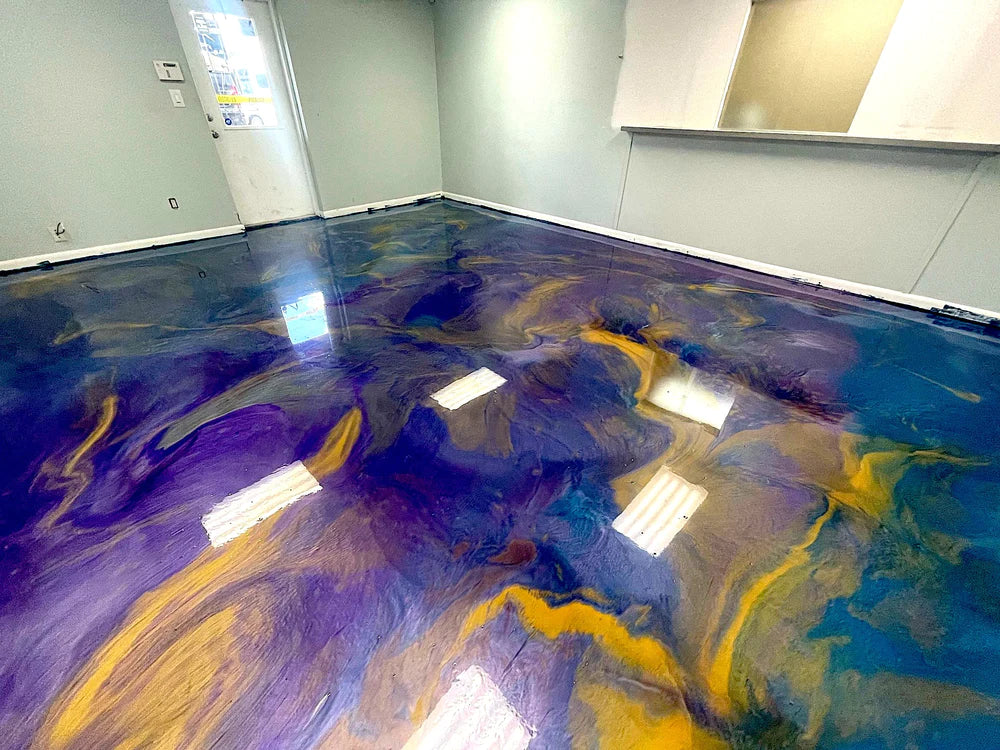
Color-shift epoxy flooring is a decorative resin floor that changes color as light and viewing angles change. A floor that looks deep teal from the doorway can turn violet or bronze as you cross the room. Under Maui’s strong afternoon sun it looks different again.
Many property owners want a floor that stands out without giving up durability. This system gives you both. It carries the same chemical resistance and easy cleanup as standard epoxy, plus a finish that shifts all day.
By the end of this guide, you’ll know:
- What color-shift epoxy is and how its pigments create the effect
- Where it performs best, and where another system fits better
- How a professional installation works, step by step
- What Maui’s sun, humidity, and salt air mean for your floor
Transform Your Floors with Experts You Can Trust
Ready to upgrade your concrete into a durable, stylish surface? Our team delivers high-quality epoxy flooring built to last in Maui’s climate.
or call 01202 985 241
What Is Color-Shift Epoxy Flooring?
Color-shift epoxy flooring is a decorative epoxy system made with interference pigments that change hue depending on the angle of light and the viewer’s position. Interference pigments, sometimes called chameleon pigments, are ultra-thin coated flakes that reflect different colors from different angles. Contractors suspend them in a clear or tinted epoxy layer over prepared concrete, then seal everything under a protective topcoat.
The result belongs to the wider family of decorative epoxy flooring, which includes metallic, flake, quartz, and 3D designs. Color-shift sits at the most dynamic end of that range.
Color-Shift Epoxy vs. Metallic Epoxy: What’s the Difference?
People often mix these two up. The difference is simple:
- Metallic epoxy uses reflective metallic pigments to create depth, swirls, and a marble or liquid-metal look. The hue stays mostly the same. Only the brightness changes.
- Color-shift epoxy uses interference pigments that change the actual color. A single pigment can move from green to blue to purple as you walk past.
Many installers combine the two. A metallic base adds movement and depth, and a color-shift layer adds the changing hue. If you want to see the metallic side first, explore our metallic epoxy flooring systems.
How Does Color-Shift Epoxy Work?
Color-shift epoxy works through thin-film interference, the same physics that creates the rainbow sheen on a soap bubble or an oil slick. Each pigment particle is a tiny platelet, usually mica or synthetic glass, coated with layers of metal oxides such as titanium dioxide or iron oxide.
Here is how it happens:
- Light hits the coated pigment. Some of it reflects off the top layer, and some passes through to the layers below.
- The reflected waves overlap. Depending on the angle, certain colors strengthen and others cancel out.
- Your eye sees the strongest wavelength. As you move, the angle changes, and so does the color you see.
This is why lighting matters so much. Natural daylight through a lanai door brings out vivid, full-spectrum shifts. Warm LED fixtures create softer, moodier tones. Directional spotlights in a showroom produce the most dramatic changes.
Before you choose colors, look at the actual sample under your room’s real lighting at several times of day.
What Are the Benefits of Decorative Epoxy Flooring with Color-Shift Pigments?
Color-shift epoxy delivers high-impact design on top of the proven performance of an epoxy floor. You get a floor that works hard and still looks like a design feature.
1. A One-of-a-Kind Visual Effect
No two color-shift floors look the same. Pigment flow, application technique, and room lighting make every installation unique. That’s a real advantage for showrooms, boutiques, and luxury homes, where first impressions count.
2. Strong Durability
A properly installed epoxy system resists:
- Heavy foot traffic
- Abrasion and scuffing
- Oil, chemical, and household spills
- Impact from dropped tools or furniture
A high-quality topcoat adds a second layer of defense, so the decorative layer stays protected underneath.
3. Easy Maintenance
The finish is non-porous, so liquids sit on top instead of soaking in. Dust, sand, and spills wipe away without scrubbing grout lines or sealing seams.
4. Brighter Spaces
The glossy surface reflects natural and artificial light. Rooms look brighter and more open, which helps in basements, interior offices, and garages with limited windows.
5. Full Customization
You control the base color, pigment blend, flow pattern, and finish level. Popular choices include:
- Ocean-inspired blue-to-green shifts that echo Maui’s coastline
- Copper-to-gold blends for warm, upscale interiors
- Purple-to-teal combinations for retail and entertainment spaces
Ask your installer for a physical sample board before you commit to a palette.
Where Does Color-Shift Epoxy Flooring Work Best?
Color-shift epoxy flooring performs best indoors, in spaces where light changes and people move through the room. Movement is what activates the effect.
| Space | Why It Works |
| Living rooms and great rooms | Daylight changes the floor’s color throughout the day |
| Home garages and showcase garages | Pairs well with car displays and overhead LED lighting |
| Basements | Reflective finish brightens low-light areas |
| Retail stores and boutiques | Creates a memorable, photo-friendly brand moment |
| Showrooms and galleries | Directional lighting maximizes the color change |
| Restaurants and bars | Builds atmosphere under ambient lighting |
| Offices and lobbies | Signals a modern, design-forward brand |
For space-specific details, see our pages on residential epoxy flooring, commercial epoxy flooring, garage epoxy flooring, and basement epoxy flooring.
Start by listing the rooms with the most natural light and foot traffic. Those are your strongest candidates.
What Are the Limitations of Color-Shift Epoxy?
Color-shift epoxy is not the right choice for every space. Knowing its limits up front helps you avoid an expensive mismatch.
- UV exposure: Standard epoxy can yellow or amber under direct sunlight. Hawaii’s UV index regularly reaches the “extreme” range of 11 or higher, so outdoor and sun-drenched areas need a UV-stable topcoat such as aliphatic polyurethane or polyaspartic coating.
- Slip risk when wet: High-gloss finishes get slick with water or sand. An anti-slip additive in the topcoat solves this. Read more in Are Epoxy Floors Slippery? What You Need to Know.
- Visible dust and fine scratches: Dark, glossy finishes show surface dust and micro-scratches faster than flake or quartz floors.
- Hard-to-match repairs: Every pour is unique, so a patch rarely blends perfectly. Repairs usually mean recoating a full section.
- Higher cost: Specialty pigments and skilled hand application cost more than solid-color or flake systems.
- Installer skill matters: The effect depends on technique. An inexperienced crew can leave streaks, puddles, or flat spots.
For pool decks and fully exposed patios, a flake or quartz system with a UV-stable topcoat holds up better. Keep color-shift for covered lanais and interiors.
How Is Color-Shift Epoxy Flooring Installed?
A professional color-shift installation follows a strict layered process, and surface preparation decides most of the outcome. Skipping steps leads to bubbling, peeling, or uneven color.
- Test the slab for moisture. Installers measure moisture vapor using industry methods like ASTM F2170 (in-slab relative humidity probes) or ASTM F1869 (calcium chloride test). Hawaii’s humidity makes this step essential.
- Grind the concrete. Diamond grinding opens the surface to the right profile, typically CSP 2–3 on the International Concrete Repair Institute scale, so the epoxy bonds mechanically.
- Repair cracks and pits. Fill damaged areas with epoxy patching compound and grind them flush.
- Apply the primer or moisture barrier. A penetrating primer seals the concrete and blocks vapor from pushing up through the floor.
- Roll out the base coat. A tinted base coat sets the background color that the pigments play against. Dark bases usually make the shift stand out more.
- Pour and work the color-shift layer. The installer mixes interference pigments into clear resin, pours it, and moves it with rollers, trowels, brushes, or air blowers to create flow and depth.
- Seal with a protective topcoat. A clear topcoat guards against scratches, chemicals, and UV. Anti-slip additives go in at this stage if needed.
- Let the floor cure. Most systems allow light foot traffic after about 24 hours, light use after roughly 72 hours, and full chemical cure in about 7 days, depending on temperature and humidity.
Ask any contractor which moisture test they use and which topcoat they recommend before you sign a quote. Their answers tell you a lot about their experience.
How Do You Maintain Color-Shift Epoxy Floors?
Color-shift epoxy needs simple, regular care to keep its shine and color depth. Most of that care comes down to keeping grit off the surface.
- Dust mop daily. A microfiber dust mop removes sand and grit before it scratches the topcoat.
- Damp mop weekly. Use warm water and a pH-neutral cleaner.
- Wipe spills quickly. Epoxy resists stains, but fast cleanup protects the finish.
- Skip harsh cleaners. Vinegar, citrus cleaners, and soap-heavy products can dull the gloss or leave residue.
- Place walk-off mats at entries. Beach sand is one of the biggest abrasion risks in Maui homes.
- Add felt pads to furniture. Pads stop scratches from chairs and tables.
- Refresh the topcoat when needed. High-traffic commercial floors may need a maintenance recoat every few years.
For a full cleaning routine, read our guide on How to Clean Epoxy Painted Floors.
Why Do Maui Property Owners Choose Color-Shift Epoxy?
Maui property owners choose color-shift epoxy because it handles island conditions and reflects the island’s natural colors. The look echoes ocean water shifting from turquoise to deep blue, which fits well in coastal homes and vacation rentals.
The island also creates specific demands:
- High humidity: Proper moisture testing and vapor barriers prevent bubbling and delamination.
- Salt air: A non-porous epoxy surface shields concrete from salt-driven deterioration, especially in coastal areas like Kihei, Wailea, and Lahaina.
- Intense UV: UV-stable topcoats keep color-shift pigments looking true near windows and on covered lanais.
- Sand and tracked-in grit: Hard topcoats resist the abrasion that wears down softer floor finishes.
Maui Epoxy Solutions installs epoxy systems across the island, including Kula, Makawao, Pukalani, Wailea, and Wailuku. Our crews build every floor for local conditions, from upcountry homes with cooler, wetter slabs to beachfront properties facing constant sun and salt.
We test every slab, specify the right topcoat for your exposure level, and show you real samples under your own lighting before installation begins. That process keeps results predictable on a finish that is, by design, one of a kind.
Is Color-Shift Epoxy Flooring Worth It?
Yes, color-shift epoxy flooring is worth it if you want a statement floor that also stands up to daily use. It costs more than solid-color or flake systems. In return, you get a design feature that changes all day and a surface built to last for years with basic care.
It is the wrong pick for fully exposed outdoor slabs or tight budgets. In those cases, a solid color or flake system gives you durability at a lower price.
Compare your top two systems side by side with physical samples before you decide.
Frequently Asked Questions About Color-Shift Epoxy Flooring
What is color-shift epoxy?
Color-shift epoxy is a decorative epoxy floor coating that contains interference pigments. These pigments change color depending on the viewing angle and lighting, so the floor looks different as you move through the room.
How long does color-shift epoxy flooring last?
A professionally installed color-shift epoxy floor typically lasts 10 to 20 years indoors. Lifespan depends on surface preparation, topcoat quality, traffic levels, and maintenance.
How much does color-shift epoxy flooring cost?
Color-shift epoxy costs more than standard epoxy because of specialty pigments and skilled hand application. Pricing depends on square footage, slab condition, design complexity, and topcoat choice. Maui projects also reflect island material and shipping costs, so request an on-site quote for accurate numbers.
Can color-shift epoxy be used outdoors?
Color-shift epoxy works on covered lanais and patios when sealed with a UV-stable topcoat. Fully exposed outdoor slabs in Hawaii face extreme UV, so flake or quartz systems with polyaspartic topcoats perform better there.
Is color-shift epoxy slippery?
Color-shift epoxy can feel slick when wet because of its high-gloss finish. Adding an anti-slip aggregate to the topcoat improves traction without hiding the color effect.
What is the difference between color-shift and metallic epoxy?
Metallic epoxy creates depth and movement but keeps mostly the same hue. Color-shift epoxy changes the visible color itself depending on angle and light.
Can I install color-shift epoxy myself?
DIY kits exist, but color-shift results depend heavily on grinding, moisture testing, and pour technique. Mistakes are hard to fix because patches rarely blend in. Professional installation gives you a consistent, warrantied result.
How long before I can walk on a new color-shift epoxy floor?
Most floors allow light foot traffic after about 24 hours and normal use after about 72 hours. Full chemical cure takes around 7 days, so wait before placing heavy furniture or parking vehicles.
Bring Color-Shift Epoxy Flooring to Your Maui Property
Color-shift epoxy flooring gives you a surface that changes with every sunrise, light switch, and step across the room. It combines the toughness of epoxy with one of the most striking finishes in decorative epoxy flooring.
Results depend on the installer. Moisture testing, proper grinding, the right topcoat for Hawaii’s UV, and a practiced hand on the pour separate a stunning floor from a costly redo. Maui Epoxy Solutions handles every one of those steps for homes and businesses across the island.