

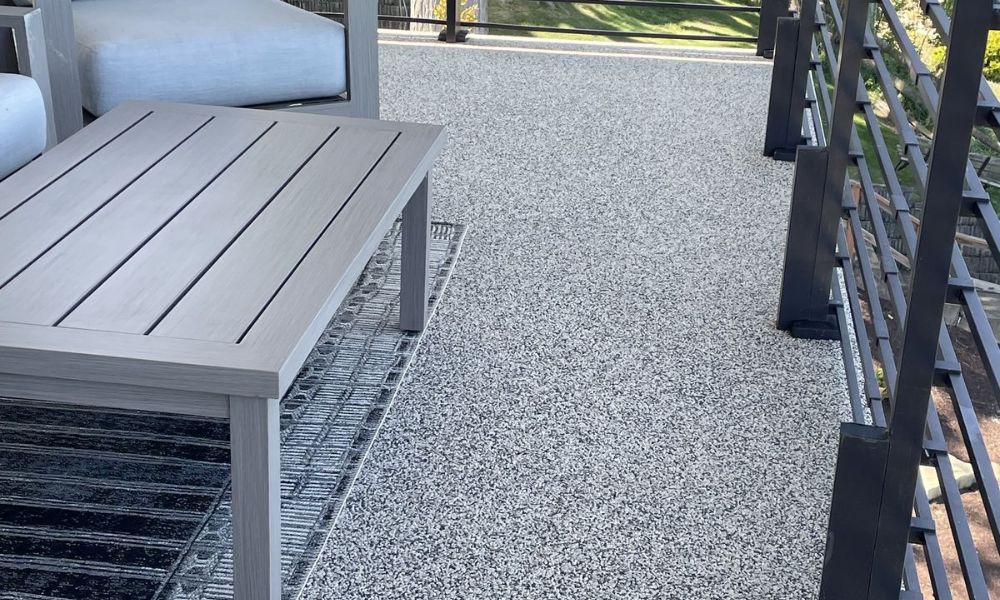
Epoxy deck coating can be a practical upgrade for Maui outdoor spaces when the right product is selected and the surface is properly prepared. It offers durability, slip-resistance options, and design flexibility—but Maui’s UV intensity, humidity, and salt air mean product selection and installation conditions are critical to long-term performance.
Maui’s outdoor lifestyle puts real demands on surface coatings. Homeowners here deal with intense UV exposure, high humidity, coastal salt air, frequent rain, windblown sand, and—for many properties—regular pool chemical contact. An existing concrete deck can absorb all of that punishment until it starts showing cracks, staining, and surface deterioration that’s both an eyesore and a safety concern.
Epoxy deck coating is one solution worth considering. It protects the concrete beneath, improves the appearance of aging surfaces, and can be configured with slip-resistant finishes suited for wet environments. Whether it’s the right choice for your specific space depends on several factors this guide will walk you through clearly.
At a Glance — What Is Epoxy Deck Coating?
Epoxy deck coating is a resin-based surface system applied over concrete. It typically includes a primer, a base coat, optional decorative materials, and a protective topcoat. When properly installed over a clean, mechanically prepared substrate, it can provide a durable, customizable surface that helps protect the concrete beneath from moisture, staining, and physical wear.
What Is Epoxy Deck Coating?
Epoxy is a two-part system: a resin and a hardener that chemically react when combined. Once cured, the material bonds to the concrete substrate and creates a hard, protective layer. A complete coating system generally includes:
- Primer — penetrates the concrete and promotes adhesion
- Base coat — provides color and the first layer of protection
- Decorative elements — such as flakes, [quartz](Quartz Flooring), or colored chips for texture and visual interest
- Protective topcoat — seals the surface and determines finish, sheen, and slip resistance
Surface preparation is what separates a coating that lasts from one that peels within a season. The concrete must be mechanically opened—typically by diamond grinding or shot blasting—so the epoxy can penetrate and bond correctly. No amount of product quality compensates for a poorly prepared surface.
8 Benefits of Epoxy Deck Coating
- Durable Surface
When properly applied, epoxy can withstand foot traffic, furniture movement, and the general wear of an active outdoor space. - Easy Maintenance
The smooth, sealed surface resists dirt and is generally easier to clean than bare or sealed concrete. - Custom Appearance
Epoxy supports a wide range of decorative finishes—solid colors, broadcast flakes, [quartz](Quartz Flooring) blends, and textured systems—giving homeowners meaningful control over how the final surface looks. - Stain Resistance
A properly sealed epoxy surface helps resist common staining sources including sunscreen, food and beverage spills, and pool chemicals. - Slip-Resistance Options
Additives such as aluminum oxide or quartz aggregate can be incorporated to improve traction on wet surfaces. Slip resistance is not automatic—it depends on the system specified and how it’s installed. - Protection for Concrete
Epoxy slows moisture infiltration, helps prevent further surface degradation, and can extend the functional life of an aging concrete deck. - Outdoor Design Flexibility
Epoxy systems can be applied to [pool decks](Pool Deck Coating), [patios and lanais](Patio & Lanai Epoxy), and vacation rental outdoor areas, with finishes that complement a variety of architectural styles. - Suitability for Maui Applications
With the right product selection—specifically UV-stable formulations with compatible topcoats—epoxy can be configured for the conditions Maui outdoor surfaces regularly face.
Is Epoxy Deck Coating Good for Maui’s Climate?
Maui’s environment is demanding, and not every epoxy product is built to handle it.
UV exposure is the most significant consideration. Standard epoxy resins can yellow and chalk under prolonged sun exposure. A UV-stable topcoat or a [polyaspartic](Polyaspartic Coatings) finish coat can help reduce this effect, but product selection matters significantly.
Humidity and rain affect both installation and long-term performance. Epoxy applied over a concrete surface with elevated moisture content may delaminate. Moisture testing before application is not optional—it’s a required step.
Salt air near the coast can affect surface adhesion over time if the coating system is not specified for coastal conditions. [Resistant epoxy coatings](Resistant Epoxy Coatings) designed for marine-adjacent environments are better suited to these conditions.
Sand and abrasion from foot traffic near the beach or pool area can wear down a smooth finish faster than expected. Textured or quartz-broadcast systems generally hold up better in high-traffic zones.
Pool chemicals present regularly on deck surfaces can degrade coatings not formulated to handle chemical contact. Confirm compatibility before selecting a system for pool deck applications.
Installation timing also matters. High humidity, direct sun, and surface temperatures outside the manufacturer’s specified application window can compromise the cure and the bond. A properly timed installation—often early morning in Maui conditions—reduces these risks.
Epoxy vs. Polyaspartic Deck Coating
| Feature | Epoxy | Polyaspartic |
| UV resistance | Lower (requires UV-stable topcoat) | Higher (UV-stable by nature) |
| Cure time | Longer (24–72+ hours depending on system) | Faster (often same-day return to service) |
| Application temperature range | Narrower | Wider |
| Flexibility | Less flexible | More flexible |
| Finish options | Broad | Broad |
| Outdoor suitability | Good with correct system | Well-suited for outdoor use |
| Typical use case | Patios, lanais, interior-adjacent areas | Pool decks, high-UV, high-traffic outdoor spaces |
For many Maui outdoor applications, [polyaspartic coatings](Polyaspartic Coatings) offer practical advantages—particularly faster return to service, better UV performance, and a wider installation temperature window. The right choice depends on the specific surface, use case, and performance priorities.
How Is Epoxy Deck Coating Installed?
Step 1 — Inspect the Deck
Assess the concrete for cracks, spalling, delamination, and previous coatings. Existing sealers or coatings must be identified and removed.
Step 2 — Repair the Concrete
Fill cracks and repair damaged areas with compatible patching materials. Coating over structural defects will not fix them.
Step 3 — Clean the Surface
Remove oil, grease, dirt, algae, and contaminants. Contaminated concrete prevents proper adhesion regardless of surface profile.
Step 4 — Mechanically Prepare the Surface
Diamond grinding or shot blasting opens the concrete pores and creates the surface profile required for the coating to bond.
Step 5 — Check Moisture
Test the concrete for moisture vapor transmission. Excess moisture is a leading cause of coating failure. Do not proceed if readings exceed the manufacturer’s specified threshold.
Step 6 — Apply the Coating System
Apply the primer, then the base coat according to manufacturer specifications. Mixing ratios and pot life must be followed precisely.
Step 7 — Apply a Compatible Topcoat
The topcoat determines durability, UV resistance, sheen level, and final slip characteristics. Confirm topcoat compatibility with the base coat system.
Step 8 — Cure and Inspect
Allow the system to cure fully per manufacturer specifications before returning the deck to service. Inspect for any areas requiring touch-up.
Common Epoxy Deck Coating Mistakes
- Using an interior-only product outdoors — Interior epoxy is not formulated for UV exposure or outdoor moisture conditions.
- Skipping concrete preparation — Coating over unprepared concrete almost always results in premature adhesion failure.
- Coating contaminated concrete — Oil, grease, or prior sealer residue will prevent the epoxy from bonding.
- Ignoring moisture — Applying over concrete with elevated moisture content is a primary cause of delamination.
- Applying during unsuitable weather — High humidity, extreme heat, or surface temperatures outside the manufacturer’s window compromise the cure.
- Choosing an overly smooth finish for wet areas — A high-gloss finish without slip additives can become hazardous when wet. .
- Applying incompatible topcoats — Not all topcoats are compatible with all base coat systems. Confirm compatibility in writing before mixing products from different manufacturers.
- Returning the deck to service too quickly — Light foot traffic and furniture placement before full cure can damage the surface before it reaches its rated hardness.
Where Can Epoxy Deck Coating Be Used in Maui?
- [Pool Decks](Pool Deck Coating) — High-traffic, wet, and frequently exposed to pool chemicals. Slip-resistant, chemical-tolerant systems are recommended.
- Patios — Residential patios benefit from decorative systems like Patio Epoxy Flooring that combine function with visual appeal.
- [Lanais](Patio & Lanai Epoxy) — Covered or partially covered lanai surfaces are well-suited to epoxy systems, with UV exposure being a key specification factor.
- Vacation Rental Outdoor Areas — High turnover and frequent use make durability and easy maintenance particularly valuable.
How to Maintain an Epoxy Deck in Maui
Epoxy decks are easier to maintain than bare concrete, but they are not maintenance-free. Regular care helps protect the coating and extend its service life:
- Sweep or blow off sand and debris regularly, as abrasive particles can wear down the finish over time
- Clean up spills promptly, particularly sunscreen, food, and pool chemicals
- Use cleaning products compatible with coated surfaces and follow the manufacturer’s cleaning guidelines
- Avoid harsh solvents or pressure washing at angles that could lift the coating edges
- Keep drains and drainage paths clear so water does not pool on the surface
- Inspect the surface periodically for chips, cracks, or areas where the coating has lifted, and address them before moisture infiltrates
Is DIY Epoxy Deck Coating Worth It?
DIY epoxy kits are available, and some homeowners complete these projects successfully on small, well-prepared surfaces. However, the work requires mechanical surface preparation equipment, precise product mixing, correct moisture testing, and the judgment to recognize when conditions are unsuitable for application. Errors in any of these steps typically result in coating failure—and removal and recoating costs that exceed what a professional installation would have cost initially.
For Maui outdoor surfaces, where UV intensity, humidity, and salt air add complexity to product selection and application conditions, professional installation generally reduces the risk of early failure. Maui Epoxy Solutions works with homeowners to assess the existing surface, recommend the right coating system for the specific conditions, and install it correctly the first time.
If you’re considering an epoxy or polyaspartic coating for your outdoor space, describe the surface condition and how the area is used—that’s the most useful starting point for determining what the project actually requires.
Frequently Asked Questions
What is epoxy deck coating?
Epoxy deck coating is a two-part resin system applied over concrete surfaces. It typically includes a primer, base coat, optional decorative materials, and a protective topcoat. Once cured, it forms a hard, bonded surface layer that protects the concrete and improves its appearance.
Is epoxy deck coating good for outdoor use?
Epoxy can be used outdoors, but product selection is critical. Standard epoxy resins are not UV-stable and will yellow or chalk under prolonged sun exposure. Outdoor applications require UV-resistant formulations or a compatible UV-stable topcoat.
Is epoxy deck coating slippery when wet?
A smooth epoxy finish can be slippery when wet. Slip resistance is not a default property—it depends on the system used and whether slip-resistant additives such as aluminum oxide or quartz aggregate are incorporated during installation.
How long does epoxy deck coating last?
Service life varies depending on the product, surface preparation quality, traffic levels, and maintenance. A properly installed system on a well-prepared surface can provide several years of performance, though Maui’s UV and coastal conditions make product selection and topcoat quality particularly important.
Can epoxy deck coating withstand Maui’s sun?
Standard epoxy resins are susceptible to UV degradation. In Maui’s high-UV environment, a UV-stable topcoat or a polyaspartic finish coat is recommended to reduce yellowing, chalking, and surface breakdown over time.
Can epoxy deck coating handle salt air?
Coastal salt air can affect coatings not formulated for marine-adjacent conditions. Specifying a system designed for coastal environments, and ensuring proper surface preparation and sealing, helps reduce the risk of adhesion failure or surface degradation.
Can epoxy be applied over an old concrete deck?
Yes, in most cases—provided the concrete is structurally sound, free of contamination, and properly prepared. Existing sealers or coatings must be removed. Cracks and damaged areas should be repaired before the coating is applied.
What is better for an outdoor deck, epoxy or polyaspartic?
For Maui outdoor surfaces, polyaspartic coatings often offer practical advantages: faster cure times, better UV resistance, and a wider installation temperature window. Epoxy may be appropriate for specific applications or as part of a hybrid system. The right choice depends on the surface conditions, use case, and performance requirements.
How do you maintain an epoxy deck?
Regular sweeping to remove abrasive sand and debris, prompt cleanup of spills, use of manufacturer-approved cleaning products, and periodic inspection for surface damage are the core maintenance requirements. Avoid harsh solvents and keep drainage paths clear to prevent standing water.